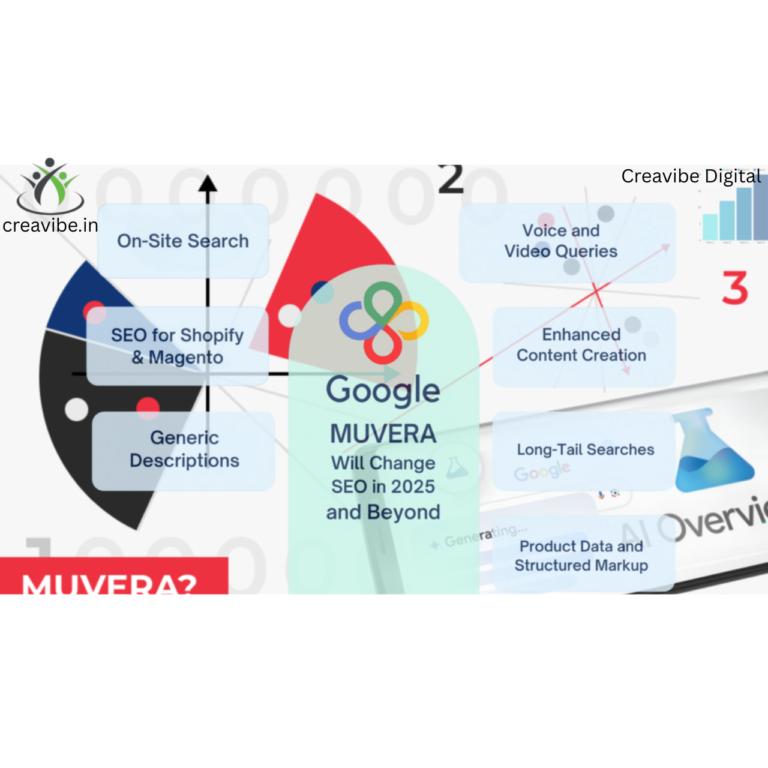
What is Muvera update?
With the Muvera update coming in June 2025, Google has made another big change to its well-known search engine. The new Google Muvera algorithm, called MVRFDE or “MUVRT” for short, marks a major improvement in how it processes information. The results of keyword searches move far beyond pure keyword matching between documents towards more intuitive paths directly linked to the topic searched for by the user behind each query.
What Makes Muvera Different?
Muvera stands for Multi-Vector Retrieval Algorithm. Google now breaks each query into several parts, including topic, context, and action. It then searches for answers that match all these elements. This helps Google handle complex and conversational searches in a more human-like way.
Muvera: The Science Behind Multi-Vector Retrieval
- Unlike previous algorithms that matched entire pages or queries to a single “vector” or digital summary. The Muvera algorithm embeds and interprets each word, phrase, and context separately using advanced AI and neural networks. However, this technology enables Google to break down complex, conversational queries and return answers that actually match user intent—even if the exact keywords aren’t present.
- Semantic search means that Google understands context, subject, and action, rather than just words.
- The intent-based search model provides more accurate and personalized results for each query.
- Multi-vector retrieval matches users’ needs quickly and accurately, even in complex, layered searches.
Why is the Muvera update important for SEO?
The Muvera update is a move from just keyword-based optimization to broader, context-rich content and smart SEO strategies in 2025. Google now prioritizes:
- Quality, authenticity, and “user-first” content creation.
- E-E-A-T signals (Experience, Expertise, Authenticity, Trustworthiness)—reflect genuine conversation and expertise on the subject matter.
Meanwhile, the algorithm does this by:
- Writing sensitive data.
- Technical correctness and citation quality.
- Real user engagement and satisfaction.
- Consistency of expertise across different platforms.
- Demonstrating real interaction with products/topics, not just theoretical understanding, thus increasing visibility.
- Semantic relevance through topic gathering and advanced schema markup.
- Improved core web key (site speed and user experience).
- Comprehensive answers and in-depth, well-organized information—not just keyword density
Muvera considers past searches and preferences to personalize answers. Google also has visual search. When you show a picture, it can provide specific results based on the content of the image. This creates a seamless experience for users who rely on images to find products or places.
How does Muvera affect search results and strategy?
With the Google Muvera update, search results are smarter and more in line with natural human queries, leading to fewer irrelevant results and less keyword stuffing. Websites that provide in-depth, useful, and original content are prioritized. For SEOs and marketers, this means updating strategies to include:
- Topics are aggregated instead of individual keywords.
- Improved authenticity and expertise performance.
- Rich, user-focused on-page SEO for intent-based search optimization.
The Muvera update is Google’s new search engine algorithm that improves the accuracy and speed of search results by understanding semantic context and user intent.
How Muvera Works
Most importantly, the center of Muvera is the idea of vectors. In computer science, a vector is a digital summary of meaning. Older algorithms would produce one summary for each web page. However, Muvera creates multiple summaries—one for each important aspect of the page. This process is called multi-vector embedding.
Google’s innovation lies in its ability to create multiple vectors to understand complex meanings while still working as fast as before. Instead of slowing down, Muvera uses smart compression techniques to provide better and more accurate matches without making users wait.
Impact on SEO and Content Creation
For people who are in SEO, MUVERA marks the end of keyword stuffing and the rise of semantic optimization. Instead of packing content with target phrases, creators can now build authentic, coherent narratives that reflect real expertise.
This update shows that every part of a website is important. If Google discovers a paragraph that accurately answers a searcher’s question, that section may appear at the top of search results, even if the main page is not an exact match.
Why Muvera is important
Muvera represents the next step in Google’s evolution. It bridges the gap between what people really want and the answers they get. Instead of simply rewarding keyword-stuffed web pages, Google now prioritizes authentic, experience-rich, and trustworthy content written for real people.
For businesses, this is important. To be visible online, companies need to demonstrate real expertise and explore topics thoroughly. They shouldn’t try to mislead the system by repeating keywords. Google wants to promote content that reflects trust and deep knowledge.
Real-world example:
Search results are changing
If you search for “best running shoes for flat feet that are suitable for trail running and city walking,” legacy algorithms might return a list full of “running shoes” but very little context. However, MUVERA’s multi-vector approach is designed to capture every possible activity. On the other hand, it can land and provide results suited to specific needs. It may even provide detailed comparisons from a trusted expert, along with user feedback and test data.
The Science Behind Muvera
Muvera uses a technique called fixed-dimensional encoding (FDE). This means that even though every web page has multiple “meanings,” Google compresses them all into a single digital fingerprint. Meanwhile, this way Google can bring together speed and depth—retrieving and ranking results more quickly and accurately than ever before.
This breakthrough has not only improved Google Search. It has also started to affect recommendations on platforms like YouTube and Google News. In the future, this technology could drive personalized features across many Google products.
When will Muvera be fully implemented?
It should be fully in place by the second quarter of 2026. You will see major changes by the end of 2025.
Conclusion
The Muvera update is a major shift towards a better search experience. To sum up, it focuses on people by understanding intent, conversations, and context. It looks beyond just keywords. Businesses and creators will now have to focus on real quality, expertise, and usefulness. Those who embrace these changes will remain highly visible and relevant in the new era of search.
